
Introducing psychology: Milgram
I wrote this essay for my Access to University course 2021-2022, for the psychology module (Equivalent to A-level Psychology).
Please do not plagiarise my work.
Human-written, AI-free!
Discussing Milgram: What we have learned from history
This essay will evaluate Milligram’s study of obedience, notably the ‘shock experiment’, and discuss the ethical issues surrounding the research and any justification of the controversial, renowned psychology experiment.
Milgram aimed to investigate whether Germans were predominantly obedient to authority figures due to the result of the Nazi killings during the Second World War. In his 1974 publication, The Perils of Obedience, Milgram stated, “Each individual possesses a conscience which to a greater or lesser degrees servers to restrain the unimpeded flow of impulses destructive to others” (Milgram, 1974).
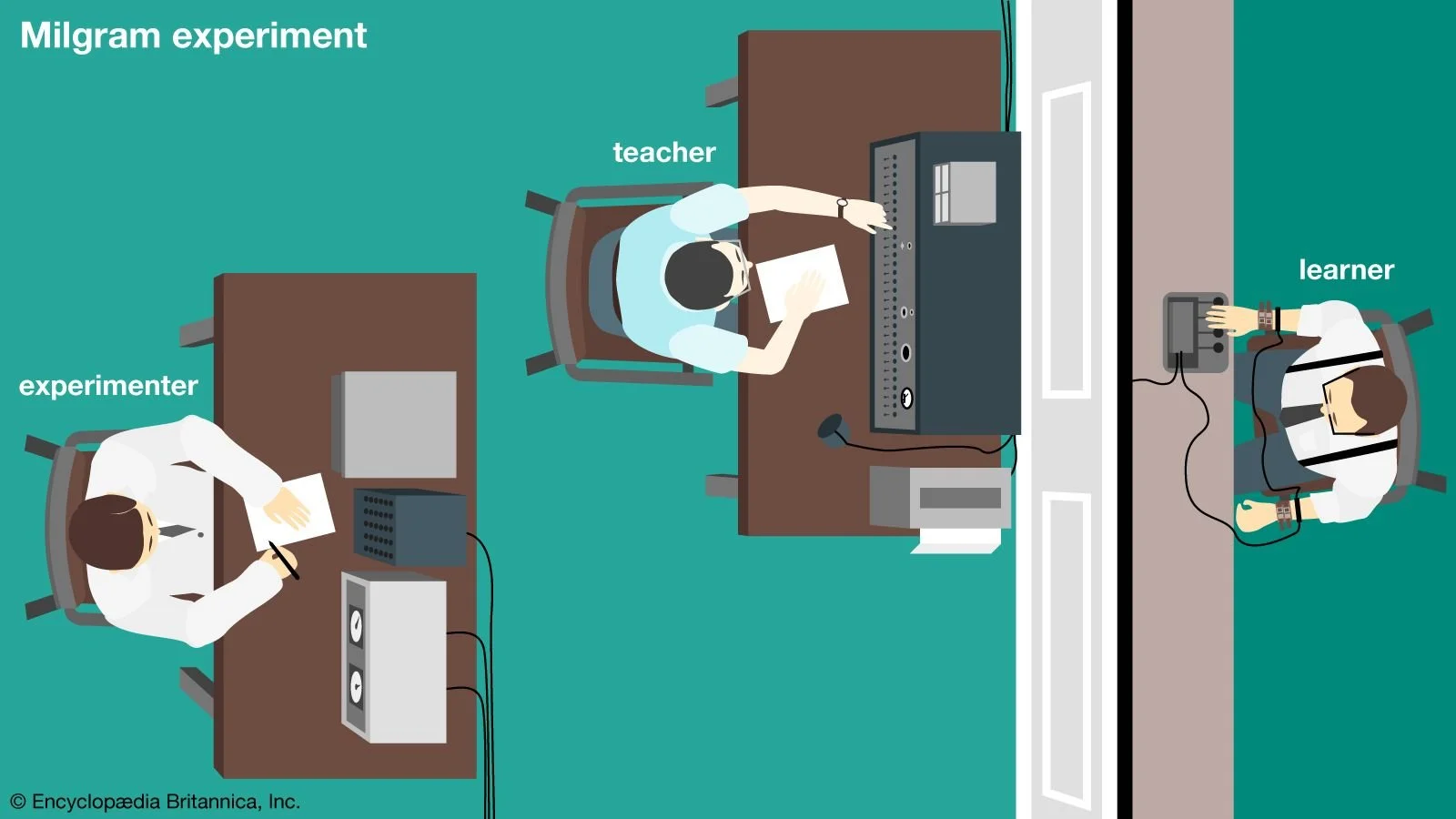
The shock test: His methodology consisted of participants being ‘Teachers’ and confederates being ‘Learners’, in which the teacher was instructed to shock the learner if they were incorrect, increasing the voltage when they continued to incorrectly answer.
The findings concluded that over half of the participants continued to 450 volts, which would cause death, and all the participants continued to 300 volts, dangerous to humans. During the 18 variations, he discovered that the majority of people would obey a person perceived as an authority figure. Milgram developed ‘The Agency theory.’ From exploring why people are obedient to a greater understanding of humanity.
Both Haslam and Reicher (2018) and Turowetz and Hollander (2018) state the importance of looking at the participants that did resist the experimenter, had some self-control and independence by withdrawing, which was based on their understanding that the Lerner was in pain through their screams across the partition and questions our understanding of the participants’ empathy (G. Perry, 2020.) Which brings us more understanding as time passes, crucial for deeper knowledge of human behaviour.
The experiment could be seen as informative and successful due to the insight of people being ingrained to obey from birth and the high compliance results. Studies completed around the globe correspondingly conclude similar results to Milgram’s, solidifying the result. Over three-quarters of the participants retorted that they were ‘glad to be in the experiment’ and did not suffer long-term repercussions in the follow-up, indicating its validity and psychological growth. Furthermore, the experiment establishes that many people’s behaviour is situational, through the use of the variations used, allowing for a broader stroke of information (McLeod, S. A, 2017).
Meanwhile, contrasting negative issues conclude that the experiment could be classified as invalid while being located in a laboratory, whereas a field experiment that would provide a real-life situation, it could be argued that the participants knew it was a study and did not respond as they may have, situationally, and they were receiving a cash reward. Additionally, the experiment could not be generalised and was biased, for example, all the participants were male; consequently, we could not have seen the results from females and if this would differ, the results. One’s interpretation could be that the participants who responded to the ad were of a certain personality type, therefore also forming a partial result on human personality behaviour. Moreover, the participants were not informed that the experiment would be beneficial for both science and society and its relevance for human development and were seen to have psychological stress during the experiment. In addition, Milligram has not discussed the participants who withdrew; thus, we cannot analyse this aspect of human behaviour without detailed data, allowing more speculation. Thus, we still have so many myths and questions on the experiment (McLeod, S. A, 2017).
Many ethical matters are raised as Milgram deceives the participants, allowing them to believe they were really shocking another human, which resulted in them feeling distressed, so much so that participants had a variety of physical signs. Furthermore, the participants were discouraged from withdrawing with four verbal prods, by means of pressure to conform and inciting breaching ethical guidelines (McLeod, S. A, 2017). We also do not know the circumstances of the participants and whether the cash reward was a factor or if they participated due to desperation.
The APA delayed Milgram’s membership due to complaints raised by one of his colleagues regarding his methods, although the APA later exonerated Milgram. The BPS prompted the first code of ethics aimed exclusively for psychology researchers (C Rivers, Editors, 2021), which changed the course of psychological research and protected participants, those involved and the scientific reputation.
Insightfully, when archives of the experiment have been available in later years, popular psychologists globally debate the contentious ethics of Milgram’s study, in addition to continual studies around the world, providing new evidence, thus the interpretation of obedience, including other related behaviours. Therefore, questioning the relevance of the experiment’s achievements, the myths surrounding it and the ethical deception. (G. Perry, etal. 2020) So we must remember that times have changed, and so has our human knowledge. Should we continue to acknowledge past times’ experiments when things were different?
When we come to explore the notion of the experiment and why, we cannot assume or presume the participant’s actions, without them directly communicating their behaviour, thoughts and feelings, as this bias does not give us factual evidence of the participant.
However, that being said, are the results of the participants’ responses on being questioned why they continued? They replied with that they in fact ‘did not believe that the learner was being harmed’ and the ‘importance of the experiment’ contrasting Milgram’s belief in the credibility of the experiment and whether Yale University would allow such ‘torture’ (G. Perry, eatal, 2020).
Professor Reicher states, “This new analysis suggests that we may have misunderstood the ethical as well as the theoretical issues raised by Milgram’s studies. We need to ask whether it is right to protect participants’ own well-being by leading them to think that harming the well-being of others can be justified as long as it is in a good cause” (The Independent, 2014).
How can we justify whether the knowledge gained about human behaviours validates the experiment? Well, in no certain terms we can’t due to our complex individuality and moral integrity, in short, who is to say what? What I believe is wrong, another may believe is not.
Can we connect the question of the behaviour of the Nazis in WW1, Milgram’s first thoughts, to his study? No, there is limited understanding, especially as we develop as a species.
In conclusion we must consider that this is all ‘theory’ and our interpretation of experiments and although we may see factual evidence from participants during some psychological studies, throughout we are looking at human behavior and self as an absorption of our own perception and one could say that we are all capable of being “theorists” when being compost mentis, thus can we justify the legitimacy of those seen as professionals and their understanding of humanity and can we ever understand humanity species as our ever changing society?
Phoenix85
Bibliography and reference list:
McLeod, S. A. (2017, February 05). The Milgram shock experiment. Simply Psychology. Available from: https://www.simplypsychology.org/milgram.html [Accessed on 18.11.21]
C. Rivers Editors, 09/06/21, The Milgram Experiment the history and Legacy of the Controversial Social Psychology Experiment, GB, Amazon.
Ted talks, 02/09/2016, The Psychology of Tyranny: Did Milgram Get It Wrong? | Alex Haslam | TEDxUQ, available from: https://www.youtube.com/watch?v=HxXMKg8-7o0 [Accessed on 18.11.21]
The New York Times Co, Obedience to Authority: An Experimental View. By Stephen Marcus, 13/01/1974, Available from: https://www.nytimes.com/1974/01/13/archives/obedience-to-authority-an-experimental-view.html [Accessed on 18.11.21]
G. Perry etal. 2020, Credibility and Incredulity in Milgram’s Obedience Experiments, Social Psychology Quarterly 2020, Vol. 83(1) 88–106, available from: https://journals.sagepub.com/doi/pdf/10.1177/0190272519861952 [Accessed on 18.11.21]
The independent, famous Milgram ‘electric shocks’ experiment drew wrong conclusions about evil, say psychologists, A. Sherwin, 05/09/2014,
Available from: https://www.independent.co.uk/news/science/famous-milgram-electric-shocks-experiment-drew-wrong-conclusions-about-evil-say-psychologists-9712600.html [Accessed on 18.11.21]
Images from Google and UnSplash.