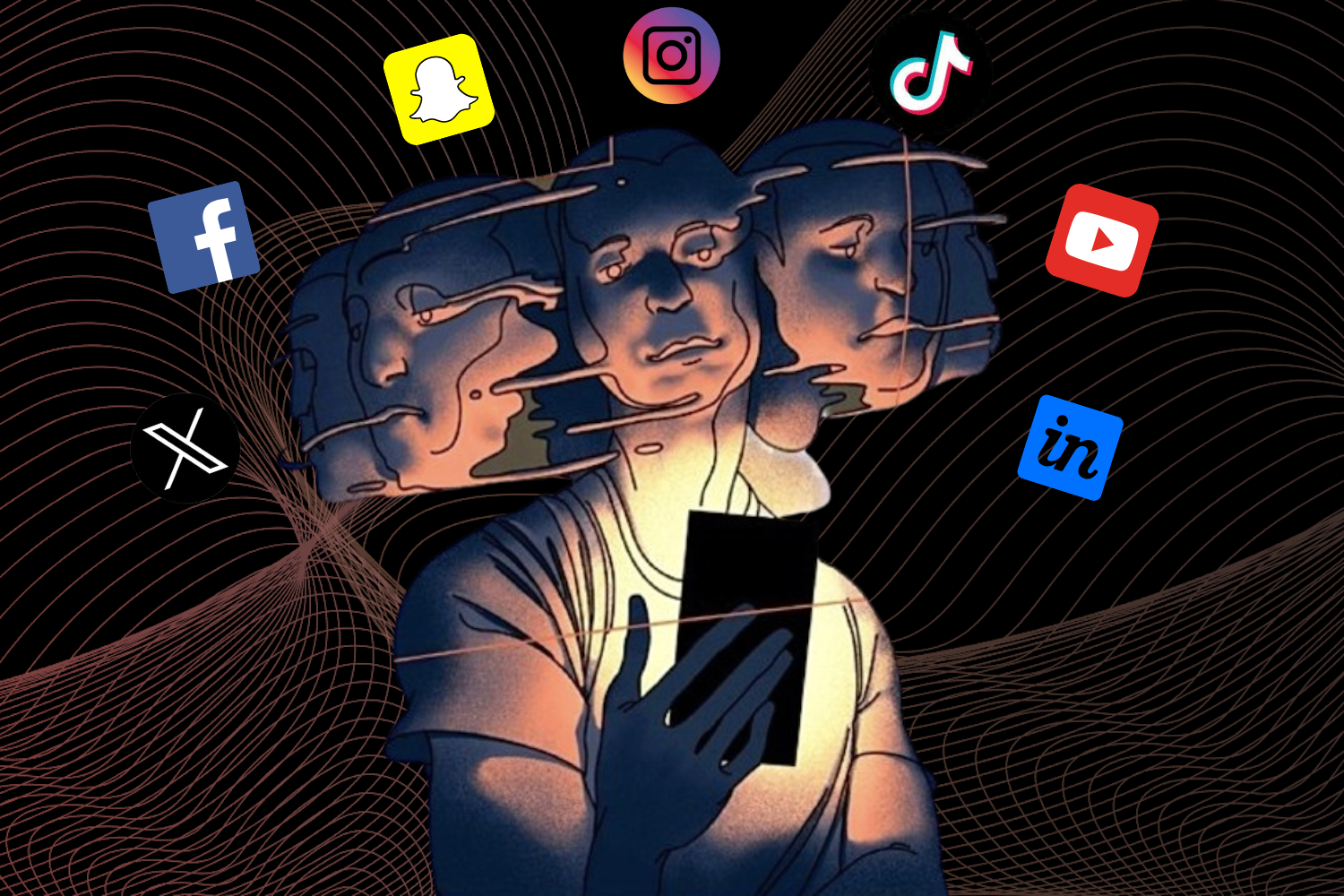
Social media addiction: Glued to our phones, missing living, and lacking connection.
A few months ago, I was late for my train, and as I stood on the very busy platform to catch my breath, I looked around, and, no word of a lie, 96% of the people surrounding me were on their phones. A deep sadness washed over me. How grim that we fill every moment we can with our phones and cannot just be anymore.
It seems that in 2026, every generation is drawn to compulsively use their phones, particularly when ‘bored,’ from young to old, not just ‘teenagers,’ as is often speculated. But this is not a new phenomenon. I mean, internet addiction is just freely accessible and socially acceptable in today’s Western (and South Asian) world.
I’ve just finished my BSc Psychology course, and last semester I took the Addictions module. For my assignment, I chose internet addiction. A subject that both interests me and affects me. Let me divulge my thoughts and research on this topic. As I was researching my assignment, I came across Young, K’s (1998) book ‘Caught in the Net’, which, in a 1996 study, proposed the rise and dangers of internet addiction, alongside the need for inpatient treatment in the USA. So, the notion of being addicted to the internet is not new; it’s just now on our phones and more accessible than ever, with free Wi-Fi almost anywhere, and 5G data, allowing individuals to browse from their phone at any given moment.
Bear in mind that back then, individuals were most likely in middle – to high-income brackets and could afford a computer/laptop and internet access. Generally, households had a ‘family’ computer back then, which was in the lounge, hallway, or parents’ bedroom. Personally, I didn’t get my own computer until I was 19 in 2005 because I couldn’t afford one, and I didn’t get internet on my phone until 2007. But when I got a computer, I became addicted to it. I spent up to 18 hours a day on it! Ask me what I did? I honestly don’t know! Today, I’m much more controlled, but I still go on it more than I should!
I think for me, what gets me is that people have forgotten how to be bored, and they end up missing out on seeing the world and connecting with others around them. For example, on another day, my train was cancelled and replaced by a bus. I saw a man waiting, asked if this was the bus, and he replied, “Yes.” So, I stood there for a minute, then complained out loud about how cold I was and how I wished I could sit on the bus while I waited. The man replied that the driver was eating, and then we began talking. We ended up sitting opposite each other and chatted the entire way. I really felt elevated after that journey, connecting with someone interesting, which I would have never experienced if my head had been stuck in my phone. Particularly since we have an ever-growing loneliness epidemic.
Another instance, I was highlighting a research paper, found something very interesting, and I said it out loud to the person opposite me. We began to chat thereafter, even after we got off the train. In both instances, I would not have encountered or enjoyed them if my head were glued to my phone. Now, one may argue about being shy, burnt out, etc., or about the difficulties of interacting with others. But trust me, I know ball when it comes to these kinda things, as young people would say. But you must be the change you wish to see in the world, for 90% of your worries don’t come true. And you will never know, if you don’t ask, or do.
There are many subtypes of internet addiction:
Social media: back then, it consisted of chat rooms and sites like Myspace. Now, social media has moved on to doomscrolling on TikTok, YouTube Shorts, and Instagram Reels.
Online gaming and gambling are vastly growing, costing the UK billions in losses, particularly for white, employed individuals (Gambling Commission, 2024).
A continuous sharp rise in sexual compulsivity, given a variety of free websites allowing porn access, particularly to children, alongside OnlyFans being easily accessible. This impacts how boys and men interact and view women. Resulting in increasing levels of erectile dysfunction in under 40’s, sexual dissatisfaction, and relationship issues, alongside increasing depression and aggression (Kirby, M. 2021).
Cyber addiction includes compulsive virtual relationships, information seeking, online shopping, and growing AI use. All of which can lead to problems, such as debt, issues with social interaction, and worsening additional addictions like alcohol and substance use, alongside insomnia and depression.
However, the problem lies in the development of children and young people’s minds, since overuse of the internet can cause neurological complications (Cash et al., 2012).
This is particularly concerning for children and teens, as the developmental period is when identity is formed, whilst the internet and digital use have become an integrated part of many individuals’ daily routine (Caner et al. 2022), with children as young as 8 owning a phone.
Moreover, children often follow their parents’ behaviour through social learning and will use their phones more often if they see their parents using them (Li et al, 2024).
Furthermore, research has linked internet addiction to higher rates of mental illness, substance misuse, poor academic performance, reduced quality of sleep and decreased sense of wellbeing (GOV, 2025).
Teenagers often lack self-regulation and use ineffective coping mechanisms, leading to maladaptive strategies to cope with overwhelm and stress and, in turn, excessive internet use. In conjunction with their increased impulsivity, teenagers have higher rates of dependency behaviours and are more vulnerable to developing mental health conditions (Antonic et al., 2025).
It is also concerning when children and teens have unsupervised internet access that is not monitored or censored, leading them to view adult content and be vulnerable to being groomed online or manipulated. Since companies are targeting the limbic system to influence people to stay online longer. Furthermore, being easily influenced by eating disorders and self-harm content, alongside cyberbullying, can have devastating effects, since teens have a high need for belonging, desire for peer approval and a fear of missing out (Montag et al, 2024).
Young’s early 1994 investigation found internet addiction to be behavioural, and individuals do not realise they have become addicts, where users get hooked on the feelings associated with the experience of logging on, which generally started innocently.
So, I implore you to be bored, to look around the world, to interact with strangers, to see beyond your phone, where real connection is. And if you’re feeling lonely, reach out to someone and meet up for a cuppa, a stroll round the park this summer, or be the village you want.
This week, my family and I played a board game instead of watching evening TV, getting back to better habits after the stress of my degree. Please remember, your family and friends are there in person, don’t miss your life as it happens, because you’re on your phone. This week, I pledge 1 hour less online, can you too? Let us get back to being connected.
Pheonix85
References:
Álvarez-Segura, M., Fernández, I., El Kasmy, Y., Francisco, E., Gallo Martínez, S., Ortiz Jiménez, E. M., & Butjosa, A. (2025). Impact of pornography consumption on children and adolescents: a trauma-informed approach. Frontiers in child and adolescent psychiatry, 4, 1567649. https://doi.org/10.3389/frcha.2025.1567649.
Caner, N., Efe, Y, S., & Başdaş, Ö. (2022). The contribution of social media addiction to adolescent LIFE: Social appearance anxiety. Curr Psychol, 41(12), 8424-8433. https://doi.org/10.1007/s12144-022-03280-y
Cash, H., Rae, C, D., Steel, A, H., & Winkler, A. (2012). Internet Addiction: A Brief Summary of Research and Practice. Curr Psychiatry Rev, (4), 292-298. https://doi.org/10.2174/157340012803520513
Gambling Commission. (2024). https://www.gamblingcommission.gov.uk/statistics-and-research/publication/industry-statistics-november-2024-official-statistics
Kirby, M. (2021). Pornography and its impact on the sexual health of men. Trends Urology & Men Health, 12: 6-10. https://doi.org/10.1002/tre.791
Montag, C., Demetrovics, Z., Elhai, D, J., Grant, D., Koning, I., Rumpf, H_J., Spada, M, M., Throuvala, M., & van den Eijnden. R. (2024) Problematic social media use in childhood and adolescence. Addictive Behaviors,153. https://doi.org/10.1016/j.addbeh.2024.107980
Li, W., Gleeson, J., Fraser, M. I., Ciarrochi, J., Hofmann, S. G., Hayes, S. C., & Sahdra, B. (2024). The efficacy of personalized psychological interventions in adolescents: A scoping review and metaanalysis. Frontiers in Psychology, 15, Article 1470817. https://doi.org/10.3389/fpsyg.2024.1470817
Sophie Wetherby, ed. James Calloway. (2026). UK Online Gambling Statistics & Market Size 2026. https://www.limelightdigital.co.uk/online-casino-game-statistics/
Young, K. (1998). Caught in the net: How to recognize the signs of internet addiction – and a winning strategy for recovery. John Wiley & sons inc.
World Health Organisation. (2025, December 9). Teens, screens, and mental health https://www.who.int/europe/news/item/25-09-2024-teens–screens-and-mental-health
https://premierscience.com/pjss-25-1058
Images from Google & upsplash (Supplied by SquareSpace).
This blog post can also be found on DigiPsyc.