
Conformity and Obedience: Can be a danger to society!
I wrote this essay as part of my Access to University course (2021-2022) for my psychology module. I find the topic interesting and thought I would share and divulge my thoughts. Some of the original essay has been adapted for this blog post…
Please do not plagiarise my work.
Human-written, AI-free!
Conformity and obedience in society: a blessing and a curse! The Holocaust is a prime example of this!
Conformity is when human behaviour, actions and beliefs are changed within a socio-economic environment. This is because we are social beings, and it appears in many cultures over history.
Why do we conform?
- To gain the approval of another and for status.
- Identification transpires when individuals are influenced by others, which can be by social pressure or influence, as explored by Zimbardo’s experiment (below).
- Normative conformity involves the primitive desire to fit in and is directed by social pressures, whilst informal conformity occurs internally.
Religious influence.
Fear of rejection.
To be liked by someone (Romantically).
When one is uncertain of a situation, they will follow others to feel safer (social proof).
Cultural influence.
Have a natural submissive personality.
To receive punishment or reward.
As an act of rebellion.
To gain community and support (Gangs ect).
Fear of being left out and following the crowd (Herd mentality).
To create an identity and be involved with something.
Fear of conflict.
This does not come without issues:
Internalisation occurs when individuals are aligned in principles with others, but feel like they cannot behave or outwardly conform, due to fear of punishment or seclusion.
Normative conformity can be dangerous as persons tend to behave in ways in which they may not ordinarily and that can be detrimental, as we see by the Stanford experiment.
The ‘bystander effect’ discourages others from intervening due to the influence of diffusion of responsibility, which could be devastating (McLeod, S. A. 2016).
Conformity due to strict rules and fear of punishment can cause further harm to vulnerable individuals, as they can be influenced by manipulative people, such as narcissists and bullies, resulting in abuse.
When people do not conform, they can be bullied, isolated, hurt or even killed!
Individuals may change who they are and lose their sense of identity, affecting their self-esteem.
Social pressure can lead to risky behaviour and illegal acts.
What about obedience and compliance?
Obedience requires a social hierarchy in which lower-ranking people comply with demands from authority figures above them. For example, teachers, law enforcement, bosses ect. Conformity is different, since it occurs among individuals of equal or unequal social standing through spoken or unspoken influence from others in the group.
Compliance is the outward appearance of conformity, regardless of whether or not one’s internal beliefs have changed (Psychology Today, 2026).
Conformity bias is the tendency to make decisions or judgments based on other people's behaviour (Very Well Mind, 2026).

The famous 1971 Stanford prison experiment by Zimbardo:
Dr Phillip G Zimbardo is a psychologist specialising in social psychology. Zimbardo was intrigued by behavioural influence and sought to discover the extent to which human behaviour is influenced by situational environment or personality.
The experiment:
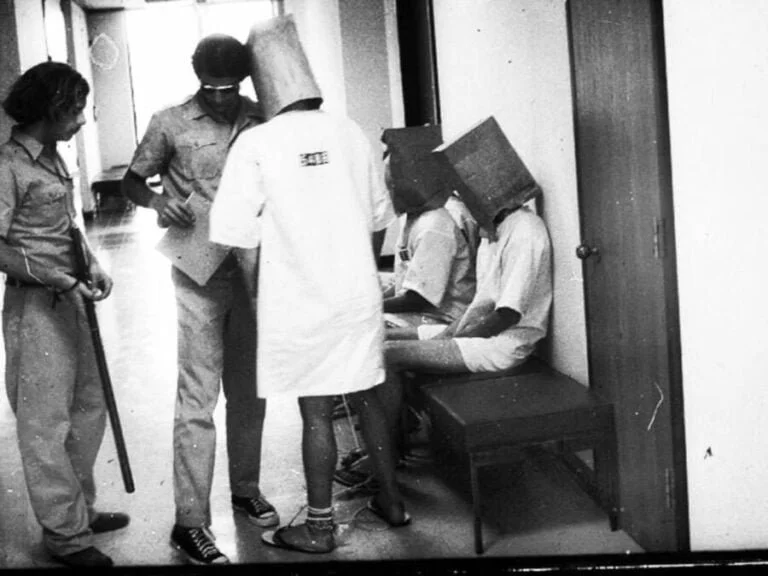
Zimbardo received permission from the U.S. Office of Naval Research for the “Stanford prison experiment,” which divided participants into guards and prisoners to study the dynamics of power and influence within a prison setting. 24 healthy men of similar socioeconomic status participated. The experiment was scheduled to last 2 weeks; however, it was cut short on day 6, due to the increasing detrimental situation, after Christina Maslach told Zimbardo that the experiment had become abhorrent and he should stop.
The results:
Demonstrated that a third of the participants were influenced by the environment, with many of the classified healthy men becoming severely emotionally distressed, particularly the prisoners who obeyed the guards and stated they ‘felt powerless, degraded and dehumanised.’ Despite the initial stress of the experiment, follow up tests results determined that none of the men suffered lasting effects.
What can we learn from the experiment?
The exploration of the authoritarian effects of leadership taught us that healthy average people can transform and become perpetrators and experience pathological reactions with dark implications. Zimbardo believes that 7 social processes lead the human character to convert and engage in evil actions, which he calls the ‘Lucifer effect’ (P Zimbardo).
The positive changes that the experiment has implemented:
A New law was implemented for federal prisons that requires juveniles to be separated from adult inmates to prevent them from psychological damage and physical harm.
Ethical guidelines changed within scientific psychology research and the ‘Belmont report’, which has three principles to implement greater safety, safeguarding and protection of participants (American Psychologist, 1988).
The negative ethical issues:
50 years later from the experiment, new material reveals that what Zimbardo explained was misleading and that the participants didn’t simply ‘slip into their roles’ as they were instructed to ensure conformity by ‘any means necessary’, including giving advice and recommendations on how to do so, together with Zimbardo addressing the guards in advance (Reicher’s, 2018).
· The prisoners were told that they could not leave the experiment.
· The prisoners did not consent to being arrested in their homes or to being subjected to being violated by their clothes being removed.
· Zimbardo was involved as a prison superintendent and became too immersed in the experiment as a participant.
· Zimbardo had never visited a real jail and created his own ideological version, which chained the prisoners’ ankles, placed them in smocks, and had no outdoor exercise, which is not a depiction of a realistic prison environment in America in that historical time.
· Zimbardo deviated from scientific protocol and published the findings in the New York Times magazine rather than in a peer-reviewed academic journal of psychology.
· Selection bias- Zimbardo only used White, middle-class, educated men and did not use a variety of persons, so it cannot be comprehensive.
· The guards were not given any training on how to present themselves appropriately, thus lacking the validity of the ‘role’ of a guard.
· It could be said that the participants were ‘acting’ during the experiment, to make it more dramatic, because it was expected, with one participant having done acting previously.
· Zimbardo did not protect the prisoners from harm.
Following others, is it in our nature?
Moscovici and the Blue/Green experiment 1969:
Serge Moscovici was a professor of social psychology. He studied groups of people andwhy they reformulate and distort the information they receive.
The ‘Minority influence’ is created over time for individuals in society, producing private acceptance of the views expressed by the minority, which can be seen through history and social shifts.
Moscovici made a distinction between compliance and conversion:
Compliance is when people publicly conform to the group norms, but can privately reject them.
Conversioninvolves a minority influencing the majority, convincing them that their views are right. involving both public and private acceptance of a new view or behaviour.
The experiment:
Moscovici researched ‘Minority vs majority’ and whether a minority can influence a majority to alter their thoughts and responses through the ‘Blue/Green’ experiment. Based in a laboratory with 172 participants, with good eyesight. In groups of six, two confederates were given instructions to give an incorrect answer of green, to see if the majority (four) would conform and reply with the incorrect answer to the 36 shades of blue colour slides presented to them. A reverse of Ashcs’ (1951) study.
Study 1: Consistently gave incorrect answers of green.
Study 2: Give an incorrect answer 24 times and a correct answer 12 times out of the 36 slides.
The results:
With the Control group (Study 2), less than 1% agreed; a consistent minority influenced participants.
When the results were done privately, the results show even higher scores of agreeability, which demonstrates that a minority can influence a majority, especially when consistent.
What can we learn from the experiment?
Minority influence can be persuasive with consistency, confidence and without bias, with their commitment to create doubt and questioning in the majority to examine their own thoughts. We see this in the suffrage movement in the 1900’s and later on in the Civil Rights movement in the 1950’s.
The negative ethical issues:
There are discrepancies in the experiment, such as:
· Participants are aware of the study, and its validity is compromised.
· The experiment could not be generalised as it used a small number of female participants, as it does not include men, especially when women tend to be more submissive and conforming than males.
Understanding the majority and minority:
Majority influence: Is when human behaviour is influenced and complies with the majority of the social public economic status. A person may have personal private views, but does not vocalise or behave differently from the “norm”, especially in public.
Minority influence: When a smaller group of people express a difference in opinion and thought process that contradicts and raises a different perspective than the majority. Over a period of time, individuals may internalise the minority in conversion, as this helps individuals to adapt and implement it. When people behave for their own gain and self-interest, people will dismiss them, rather than perceived predisposition. A “snowball effect” can be created as people distinguish acceptability and social norms.
Social cryptomnesia arises when the majority forget their influence from the minority and disregard them due to a prior negative viewpoint (Psychologists World, 2021).
Phoenix85

Bibliography and reference list:
TED conferences, Phillip Zimbardo, The Psychology of Evil, Feb 2008, available from: https://www.ted.com/talks/philip_zimbardo_the_psychology_of_evil [Accessed on 09/11/21]
Social psychology network maintained by S Plous, 1996-2001, available from: https://zimbardo.socialpsychology.org [Accessed on 09/11/21]
BBC Documentaries: Psychology: The Stanford prison experiment, 2002, available from: http://youtube.com [Assessed on 09/11/21]
APA, American Psychologist, 1988, The past and present of U.S prison policy, twenty-five years after the Stanford prison experiment, vol 53, No 7, July 1988, available from: http://pdf.prisonexp.org/ap1998.pdf [Assessed on 09/11/21]
American Psychological Association, June 8, 2004, available from: https://www.apa.org/research/action/prison [Assessed on 09/11/21]
Mark Dermont, 2019, Evaluating the criticisms of the Stanford prison experiment, Psychology Review, Nov 2019, available from: https://repository.uel.ac.uk/download/33a35c83d1bd088ddb78108c69816bccd0c712a1ea36ab5324350147f37f8571/2332153/McDermott%20M.R.%20%282019Nov%29%20Eval%20crits%20of%20SPE%20Psychology%20Review%2025219-20.pdf [Assessed on 09/11/21]
Phillip Zimbardo, 2006-2016, available from: https://www.lucifereffect.com [Assessed on 09/11/21]
S. Reicher etal, 2018, Time to change, The British Psychological Society, vol 31, Aug 2018, available from: https://thepsychologist.bps.org.uk/volume-31/august-2018/time-change-story [Assessed on 09/11/21]
Social psychology network maintained by S Plous, 1996-2001, available from: https://moscovici.socialpsychology.org [Assessed on 10/11/21]
McLeod, S. A. (2016, Jan 14). What is conformity? Simply psychology: https://www.simplypsychology.org/conformity.html
Psychologist’s world, 2021, available from: https://www.psychologistworld.com/influence/minority-influence [Assessed on 10/11/21]
Images on blog from Unsplash and header image from Google.